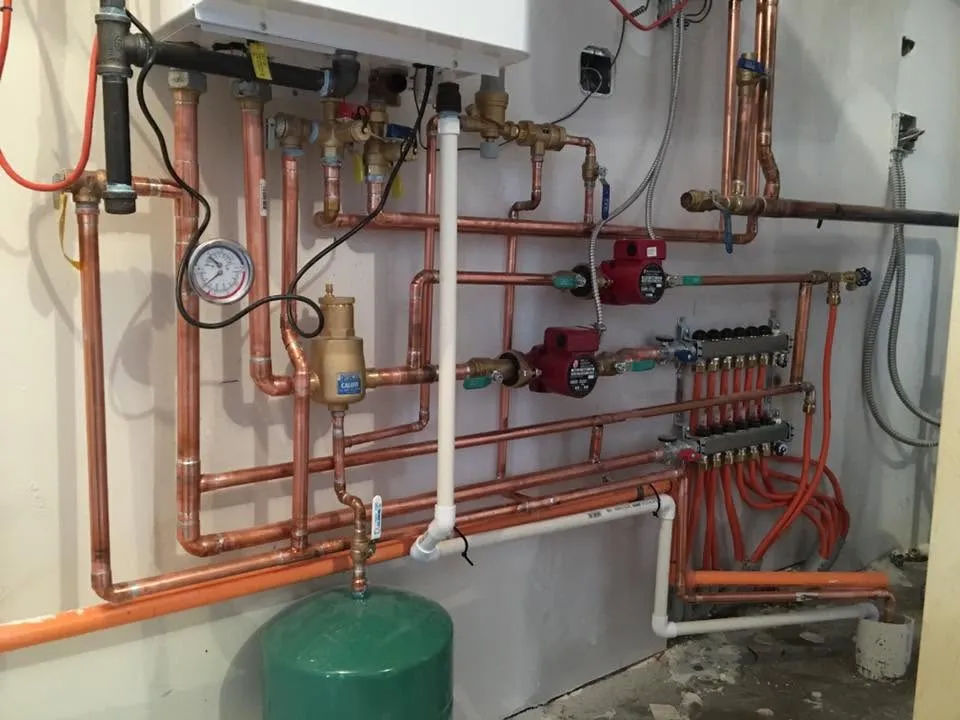
November is when a Chicago boiler either proves itself or starts making excuses. The official climate record at O’Hare still bottoms out at −27°F, set on January 20, 1985. On January 30, 2019, O’Hare fell to −23°F, with wind chills near −50°F. A typical year now includes about six or seven nights at or below zero. That is the weather a Lake County boiler has to live through, and it will not wait for a convenient service window.
Why so many homes here still heat with hot water
Bungalows, two-flats, and older houses from Evanston through Mundelein were built around boilers and radiators, or around in-floor radiant tubing. A hydronic system is quiet and steady when it is healthy. It is also a closed loop of water, metal, and safety controls. Soot on the burners, a circulator that is starting to seize, or an expansion tank that has filled with water will sit unnoticed through a mild October. The first hard cold is when those faults show up, usually as a cold room, a short-cycling boiler, or no heat at all.
What the November visit is for
A pre-winter tune-up is a combustion and safety check, plus the small repairs that keep the system from failing on a Sunday night. On a gas boiler we inspect the heat exchanger for cracks or leaks, clean the burners, confirm the igniter or pilot and the thermocouple, and look through the flue and vent for blockage. We test the pressure-relief valve, the expansion tank, the water level, and the circulator. Safety controls get a real test, and the pressure gauge gets compared with the way the system is actually behaving.
That heat-exchanger inspection matters in this climate for a specific reason. A cracked exchanger can leak carbon monoxide into the house while the boiler is running long hours. Winter is when the boiler runs those hours. Finding the crack in November is a repair. Finding it in January is an emergency, and it may be an unsafe one.
Chicago cold is a pipe problem too
Hot-water heat protects the house only while it is moving. If a circulator fails, or the power goes out during a lake-effect storm, water sits in pipes that run along exterior walls, in unheated additions, and in crawl spaces. Older Chicago-area houses have plenty of those. A tune-up will not stop a utility outage. It will tell you whether the pump, the vents, and the pressure are ready to recover once the power is back, and it is the right time to ask where the pipes are most exposed.
If the house has been through a renovation, ask for a look at the zones. A finished basement or a new addition often sits on its own loop. One zone valve that does not open will make a single room feel like the boiler is undersized, when the rest of the house is fine.
Book it before the first clipper
The first Alberta clipper of the season is a fast cold front, a little snow, and a sharp drop overnight. That is a bad evening to discover the boiler will not light. Zima HVAC is based at 1917 McRae Ln in Mundelein and works on boilers, radiant systems, and furnaces across Lake County. Call (847) 323-8314 and we will get the tune-up on the calendar while the weather is still only a warning.